
Price testing at a glance
Price tests show what customers are willing to pay, where the key price thresholds sit, and how demand will change when you increase or decrease price. At NMS, we choose the right methodology for the situation (e.g., Van Westendorp, Gabor-Granger, monadic test) and deliver a clear recommended price range, including impact by selected segments.
Quick summary:
- Recommended price range (optimal vs. maximum acceptable price)
- Price thresholds and the “too cheap / too expensive” risk
- Estimated impact of a price change on demand (price elasticity)
- Competitive price positioning (if included in the scope)
- Results broken down by segments (e.g., age, loyalty, usage)
- Interpretation: “what this means for pricing / revenue”
- Recommendations for pricing communication (what to emphasize, what to avoid)
- Option to link it with online survey research
- Option to extend with new product potential testing
What you’ll learn from price testing
- An acceptable price and the “break point” — when people start to drop off, and where the price still feels “fine”.
- Price thresholds (too cheap vs. too expensive) — when price stops looking credible, and when it starts triggering resistance.
- Price elasticity and the impact of increasing/decreasing price — we estimate what a price change will do to demand and how it differs across segments.
- An optimal price range for profit and volume — it’s not just about the “highest price”; it’s where margin can grow without needless volume loss.
- Competitive position (if you need it) — if the goal is to defend a premium or align pricing, we add brand comparison and perceived expensiveness/cheapness.
- Confidence for internal decision-making — outputs are clear for marketing, product, and sales, and can be used directly in pricing arguments.
When it makes sense (and what we typically solve)
We most often run price tests when the decision is “here and now” — and the cost of being wrong is high:
- New product / new variant — you need a launch price that the market accepts and that doesn’t kill volume. Ideally combined with new product potential testing
- Price increase or decrease — you want to know how far you can go and who will be most affected.
- Change in packaging, composition, or benefit — price changes because value changes; we validate whether customers will accept it.
- Competitive pressure / price war — you need to decide when to discount and when to hold brand value.
- Different prices for different segments — when differentiated pricing makes sense (e.g., heavy vs. light users).
Who this is typically for:
Product management, marketing, category/revenue management, commercial directors, and brand owners — anyone accountable for price and product performance.
Pricing test methods we use
We choose the methodology based on whether you’re solving for “price thresholds”, “acceptance of specific price points”, or “comparison vs. competitors”:
- Van Westendorp (PSM) — when you need price thresholds and perceived fairness.
- Gabor-Granger — when you want to test acceptance of multiple price levels and work with purchase probability.
- Monadic price test / competitive comparison — when it matters how you stand in category context (cheaper/more expensive) and what happens if you change price.
If you need a representative, numbers-based view, we lean on quantitative research.
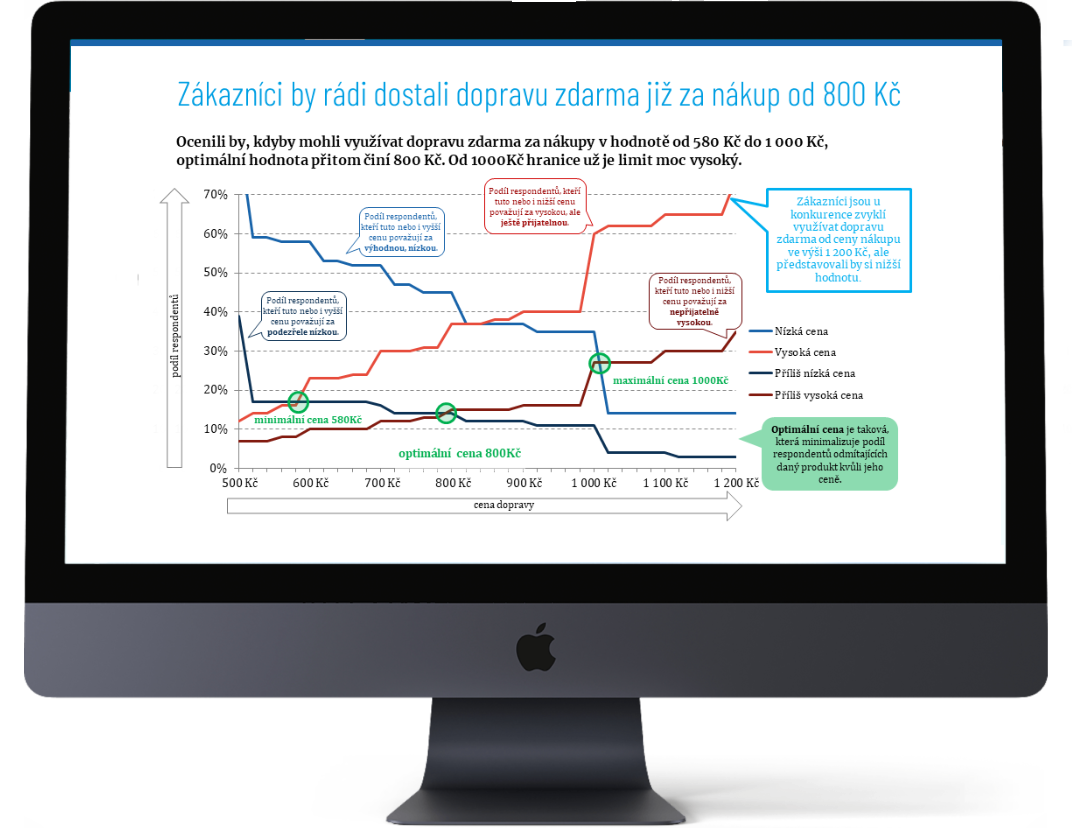
Price test outputs: a clear price range and quantified impact
We tailor deliverables to your brief, but typically you get:
- Recommended price range (optimal price + acceptance limits)
- Price thresholds and interpretation (“too cheap / too expensive”)
- Price elasticity and “what happens if…” scenarios (e.g., +5%, +10%)
- Segment breakdown (who is price sensitive and who isn’t)
- Clear conclusions and decision-ready recommendations (marketing / product / sales)
- If needed: links to follow-on product decisions — e.g., user testing to validate usability of the digital part of the offer, or logo testing when changing brand assets.
Why run price tests with NMS
- Tailored solution, not “one template for everyone” — we recommend the right method, design the questionnaire, collect data, and deliver interpretation.
- Strong analytics — pricing decisions rely on data and correct evaluation (thresholds, elasticity, segments).
- High-quality data collection — typically via our online research (speed + scalability).
- Experience and regional context — we support clients across European markets and keep recommendations practical.
Some of our satisfied clients





Questions & answers
What’s the difference between Van Westendorp and Gabor-Granger?
Van Westendorp helps identify price thresholds (price fairness). Gabor-Granger tests acceptance of specific price points and purchase probability.
When is it a good idea to run a price test?
Typically when launching a new product, planning a price increase/decrease, or when you need to confirm your price position vs. competitors.
Can you evaluate the impact of a price increase on demand?
Yes — we work with price elasticity and “price change” scenarios, ideally also by customer segments.
How many price variants can you test?
It depends on the method and category; we typically test several levels so the result is stable and interpretable.
Is price testing suitable for B2B as well?
Yes — you just need the target group of decision-makers defined correctly and the buying context understood. We adapt the methodology accordingly.
Will I also get recommendations on what to do with the results?
Yes — the deliverable is not just a table. You get interpretation and recommendations for pricing and value communication.
How do you collect the data?
Most often via online survey research on a well-defined sample.
Can we connect a price test to other product tests?
Yes — it often makes sense to add new product potential testing or other product validation.