
Customer satisfaction measurement: what you get and how to use it
Customer satisfaction measurement (NPS/CSAT/CES) tells you where you are today, how you’re trending over time, and where loyalty is leaking. At NMS, it’s not just about the “score” — we also explain the key drivers of satisfaction, provide competitive/benchmark context where it makes sense, and deliver reporting that teams can actually use across the business. You can connect the results to other CX diagnostics (customer journey mapping, online review monitoring, mystery shopping) and turn them into concrete priorities.
Quick summary:
- We measure NPS / CSAT / CES based on your goal (relationship vs. interaction vs. effort).
- We run both ongoing tracking and one-off diagnostics after a process/product change.
- You get time comparison + (where it makes sense) a benchmark/competitive view.
- We identify the key drivers of satisfaction and the “moments” where things break down.
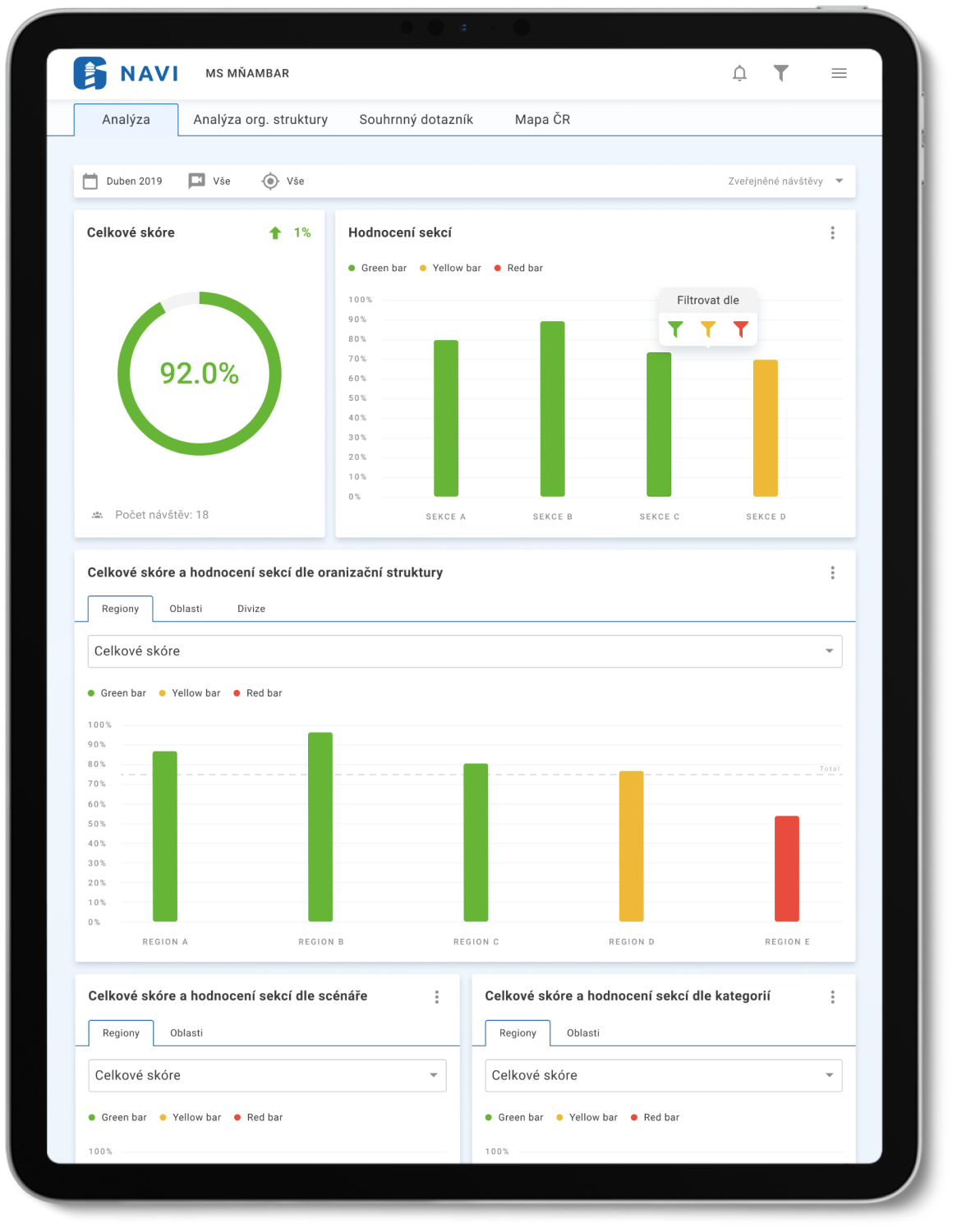
- Outputs are delivered in interactive reporting (ASAP Feedback).
- We add a segment view (where the problem is biggest / where the upside is greatest).
- We translate findings into prioritized recommendations — what to fix now vs. systemically.
- We can link this to customer journey mapping and customer experience management.
What this delivers in practice
- You stop guessing what frustrates customers and what works. You get satisfaction drivers and concrete themes from open-ended answers.
- You can compare teams / branches / channels using the same methodology. You’ll see where the issue starts — and where best practice is.
- You separate “relationship” from a specific interaction. NPS is a different animal than CSAT — and should be read and managed differently.
- You measure change instead of estimating it. Tracking shows whether process improvements actually moved satisfaction.
- Results don’t disappear into a PDF. Interactive reporting lets people filter, search, and work with data continuously.
- It’s easy to connect to broader CX diagnostics — typically to customer journey mapping or online reviews monitoring.

When this makes sense — and who it’s for
Customer satisfaction measurement pays off when you want to manage CX with data: after a process/product/communication change, when retention or conversion drops, or when you want to introduce regular tracking (e.g., after customer support contact, after purchase, after onboarding completion). Most often, this is used by CX/Customer Care managers, marketing and brand teams, retail/operations (branches), product and digital teams — and leadership that wants clear priorities instead of “feelings.”
What we measure (and when to use which metric)
- NPS (Net Promoter Score): best when you’re focusing on brand relationship and loyalty (“Would you recommend us?”).
- CSAT (Customer Satisfaction Score): when you want to rate a specific experience with a product/service or interaction (“How satisfied were you?”).
- CES (Customer Effort Score): when the issue is customer effort (“How much effort did it take to get this resolved?”).
If you want, we’ll help you combine metrics so results stay comparable over time, are easy to explain, and translate into specific improvements.
What you get from us
- Clearly defined metrics and interpretation in your context (NPS/CSAT/CES and how to read them).
- Trend over time (tracking) + the ability to compare channels/branches/teams.
- Analysis of key drivers (what pulls results up/down), including work with open-ended responses.
- Segment view (where the problem is biggest, where the upside is greatest).
- Prioritized recommendations — what to fix now, what to fix systemically, where the biggest impact is.
- Interactive reporting in ASAP Feedback, so more people can work with results (not just one analyst).
Our clients





Questions and answers
What’s the difference between NPS, CSAT, and CES?
NPS measures brand relationship and loyalty, CSAT measures satisfaction with a specific experience, and CES measures how difficult/effortful it was for the customer to resolve a request.
Is measuring only NPS enough?
NPS is a good “thermometer,” but often doesn’t explain why. That’s why it’s typically paired with follow-up questions and driver analysis.
When does a one-off measurement make sense vs. tracking?
One-off measurement is useful when you need a fast diagnosis (e.g., after a process change). Tracking is used when you want to manage trends and validate the impact of changes over time.
Can you measure satisfaction after a specific touchpoint (support, branch, delivery)?
Yes — typically post-contact / post-purchase collection, where CSAT/CES is measured and reasons behind the rating are added.
Will I get only a report, or also recommendations on what to change?
Deliverables include priorities and interpretation (what has the biggest impact on satisfaction and where to start).
Can you connect this with other CX data?
Yes — it often makes sense to combine it with online reviews monitoring or customer journey mapping.
How fast can we start?
It depends on scope and access to contacts/data. For smaller projects, measurement can be set up quickly; for tracking, correct methodology and reporting setup is key.