
Brand perception: the quick answer
Brand perception research shows which associations, emotions, and attributes people connect with your brand — and how you differ from competitors. With representative data, you’ll see what to emphasize in communication, where trust barriers appear, and which segments perceive you best. We deliver clear conclusions and recommendations you can use for brand strategy and campaigns.
Quick summary:
- we measure the key attributes of your brand image and their strength
- we benchmark you against competitors
- we show what drives preference — and what holds it back
- we separate “I know it” vs “I see it as relevant” (image ≠ awareness)
- we break results down by segments (target groups, regions, demographics)
- we translate data into recommendations for positioning and messaging
- results are actionable for communication and media strategy
- we can follow up with brand awareness measurement
What brand perception is — and why measure it
Brand perception is the sum of how people “read” you: which attributes they assign to you, what emotions you trigger, who you make sense to, and what makes you different. In practice, it determines whether your communication becomes a “nice claim” — or an actual reason to buy.
- What people trust about your brand — and what they doubt
- How you compare to competitors (benchmark)
- Which attributes drive preference — and which block it
- Where perception differs across target groups (segments)
- What it means for positioning and messaging (recommendations)
What you get from brand perception research
- Clearly named brand strengths — what truly works as a reason to choose you and deserves a place in your communication.
- Trust barriers uncovered — what people see as a weakness (and where it makes sense to adjust product, service, or messaging).
- A defensible competitor comparison — not a “feeling”, but a benchmark for market-position decisions.
- Target-group breakdown — you’ll see who perceives you best and where the biggest growth opportunity is (also a strong input for customer segmentation).
- Inputs for strategy and campaigns — we translate findings into what to say, to whom, and why (connected to communication and media strategy).
- A measurable basis for long-term brand management — usable for repeated measurement (tracking) and monitoring change over time.
When brand perception research delivers the most value
Brand perception research is most useful when you need to decide on positioning, communication, or brand change based on data — not internal opinions. Typical cases: your brand is “known” but not preferred, or you need to verify what truly differentiates you from competitors (vs what is only your internal narrative).
You’ll benefit most before a rebrand, before major campaign investment, when entering a new category/market, or when you want to validate impact over time. We can break results down by target groups and connect them to follow-up decisions — for example via customer segmentation or as an input for communication and media strategy.
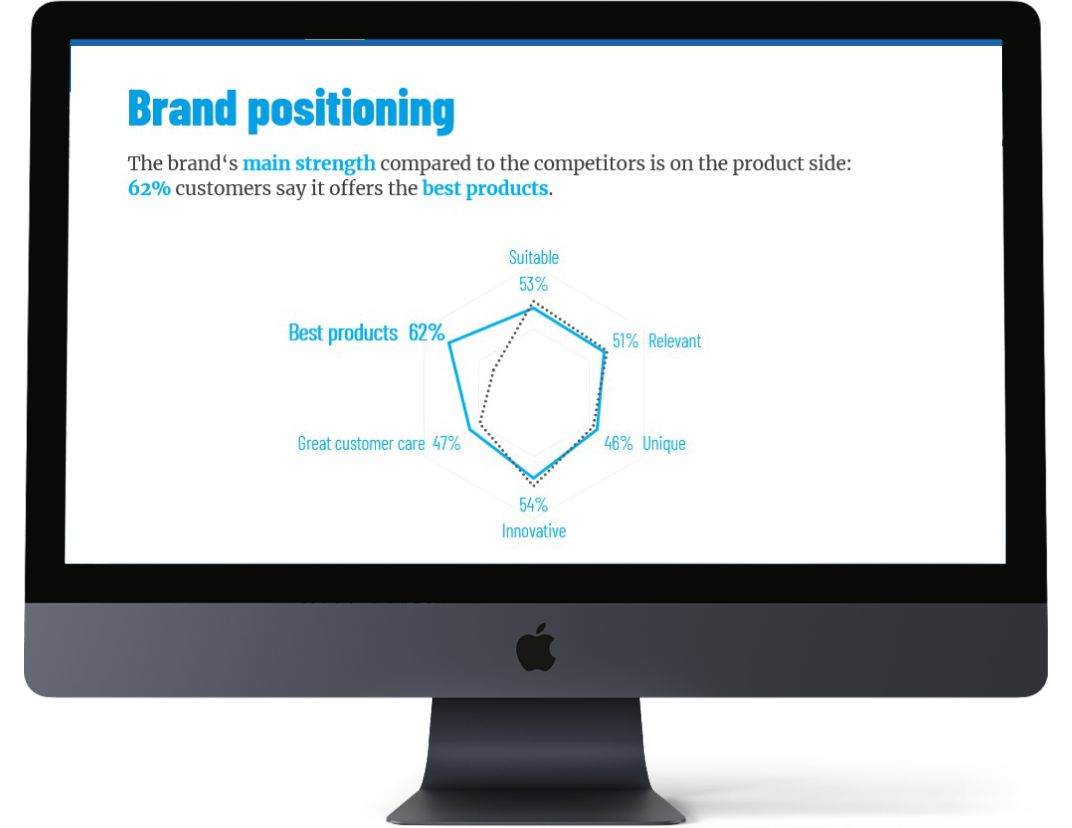
What we deliver (so you can act on it right away)
- A clear report with conclusions — what drives preference, what blocks choice, and where the biggest opportunity is.
- A perception map vs competitors — comparison of key attributes with a clear “so what” interpretation.
- A segment view — where the brand resonates most and which target groups have the highest potential (with a link to customer segmentation).
- Recommendations for positioning and messaging — what to communicate, what not to push, and where to align promises vs reality.
- Foundations for follow-up measurement — if you want to track change, we set metrics so they can be repeated reliably over time (tracking).
Credible data — not opinions
We measure brand perception in a way that holds up when you’re making decisions about budgets and strategy. We adapt the methodology to your target group and market — typically quantitative (representative), and where it adds value, we add the “why” via qualitative research. For context, quantitative research can be helpful too.
Our clients


Questions & answers
What is brand perception research?
It measures which attributes, associations, and emotions people connect with your brand — and how you compare to competitors.
What’s the difference between brand perception and brand awareness?
Awareness answers “Do they know/notice you?”. Perception answers “What do they think about you?”. Brands often have high awareness but weak reasons to choose them.
Can you compare competitors as well?
Yes — benchmarking is one of the most common parts of this research because it provides the context of “good vs average” in your category.
What decisions is this best for?
Positioning, messaging, rebranding, prioritising communication themes, and validating what truly drives preference.
Can you break results down by target groups?
Yes — we typically break down results by segments and provide recommendations on what to communicate to whom (ideally connected to customer segmentation).
Is it only a quantitative survey?
Not necessarily. Most often the base is representative quantitative research, but if you need to explain the “why”, we add qualitative insight.
What do I get as an output?
A clear report with conclusions, competitor benchmarks, segment views, and recommendations for positioning and communication.
How does it connect to communication and campaigns?
The research shows what is credible and relevant — and what you should avoid pushing. An ideal input for communication and media strategy.