
Customer segmentation in a nutshell
Customer segmentation splits a market into groups of people with shared needs and behaviours so you can target your offer, product, and communication more precisely. At NMS, we build segmentation on data (most often online research), use advanced statistics, and deliver outputs you can use immediately: segment descriptions, personas, and actionable recommendations for marketing and growth. Typically, it helps you identify the highest-potential segments and stop “shooting in the dark”.
Quick summary:
- We identify segments based on needs, motivations, and behaviours (not just demographics).
- We quantify segment size and business value/potential.
- We deliver segment profile cards + “how to recognise them” in data and in practice.
- We prepare recommendations for targeting, offer, and messaging.
- We can connect segmentation to brand measurement and evaluate communication impact.
- Data collection is typically handled via online research.
- We rely on strong know-how and data quality (including panel data) and experienced analysts.
- Outputs are designed to be usable across marketing, product, and CX.
What segmentation gives you in practice
- More precise targeting — you know who is worth addressing and why (not just age and gender).
- Clearer positioning and messaging — each segment responds to different triggers; we deliver a map of needs and motivations you can build communication on.
- Smarter budget allocation — you invest in segments with the highest potential (size × reachability × relevance).
- Inputs for product and offer design — segments often reveal “white space”: what to adjust in your offer, bundles, or service.
- Personas that are understandable and not made up — derived from data, not from a workshop.
- Follow-up impact measurement — we can link segmentation to studies like brand awareness research or brand perception & evaluation and track how your brand evolves over time.
When segmentation makes sense
Segmentation pays off when you feel “the market is too broad” — and decisions are based on an average customer who doesn’t actually exist. Companies typically use it as a foundation for marketing strategy, campaign planning, offer innovation, or identifying new market opportunities.
Typical scenarios:
- You’re launching or changing communication and need to anchor it in real needs (good overlap with communication audience).
- You’re trying to understand churn or stagnant growth — segments often reveal different “jobs to be done” (can be combined with purchase behaviour research).
- You need to justify investment — segmentation provides clear numbers (segment size, potential, prioritisation).
Who benefits most from segmentation
Segmentation is most often used by marketing/brand teams (targeting, messaging, strategy), product teams (offer adjustments, concepts), CX/CRM (personalisation, retention), and sales (segment-specific value arguments).
We run segmentations for consumer and B2B markets. The main differences are the data sources and how the decision-making unit is defined (individual vs. company + stakeholders). We can build data collection on either panel data or a client database within quantitative research.
Customer segmentation deliverables
We deliver outputs that are usable in practice — for a management presentation as well as day-to-day work in marketing and product:
- Segmentation model — clearly defined segments (what differentiates them, their needs, motivations, barriers).
- Segment size and profile — sociodemographics, behaviours, experiences, needs — based on what matters for your business decisions.
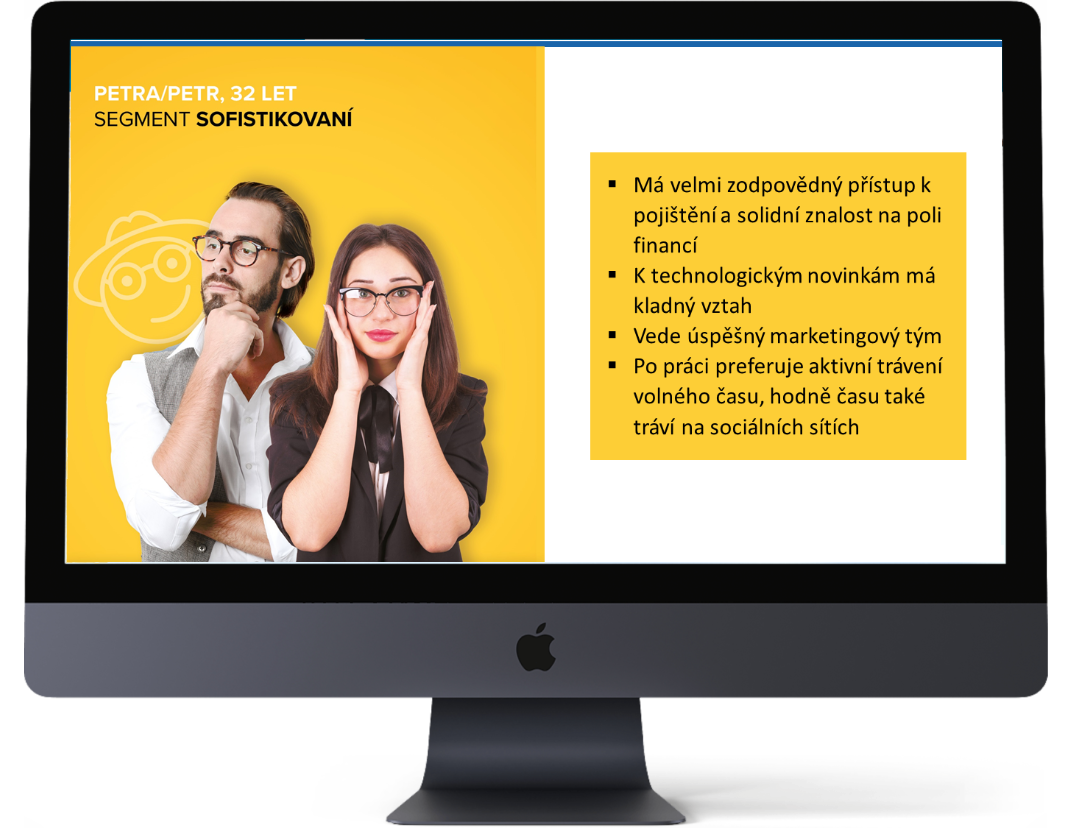
- Segment profile cards / personas — an easy-to-digest one-pager for each segment (who they are, why they buy, what they expect, how to recognise them).
- Segment prioritisation — which segments make the most sense (potential × reachability × relevance).
- Targeting & communication recommendations — how to adapt messaging, offer, and channels for key segments (communication & media measurement).
- Data output for further work (as needed) — so segmentation can be reused in follow-up analyses and tracking.
Segmentation often becomes the basis for further brand measurement and activity impact evaluation (natural overlap with brand awareness research).
Some of our happy clients include

Questions & answers
What is customer segmentation?
It’s splitting a market into groups of people with shared needs and behaviours so you can target your offer and communication more precisely.
What’s the difference between market segmentation and customer segmentation?
In practice, the terms often overlap. Market segmentation maps the whole market; customer segmentation works with your (or potential) customers. It depends on your objective and the data available.
What types of segmentation exist?
Most commonly: demographic, behavioural, psychographic, and needs-based (by needs/motivations). In deliverables, we combine what matters most for decision-making.
Can you do segmentation for B2B?
Yes. B2B segmentation typically distinguishes firmographics (company type) and decision roles/stakeholders. It often requires different recruitment and data collection than B2C.
How large a sample do we need?
It depends on how heterogeneous the market is, the number of segments, and the confidence level you need. If you’re targeting specific groups, we typically rely on targeted online data collection.
What do I get as an output — just a presentation?
No. The standard is segment descriptions, segment profile cards/personas, and targeting/communication recommendations — and, if needed, a data output for further analyses.
How do I use segmentation in marketing and communication?
It helps you choose the segments worth investing in and align messaging and channels to what is relevant for each group (you can also connect it to communication audience).
Does segmentation connect to brand measurement?
Yes. Segmentation often adds context to brand-study results and enables you to track impact by segment (see brand awareness research).